
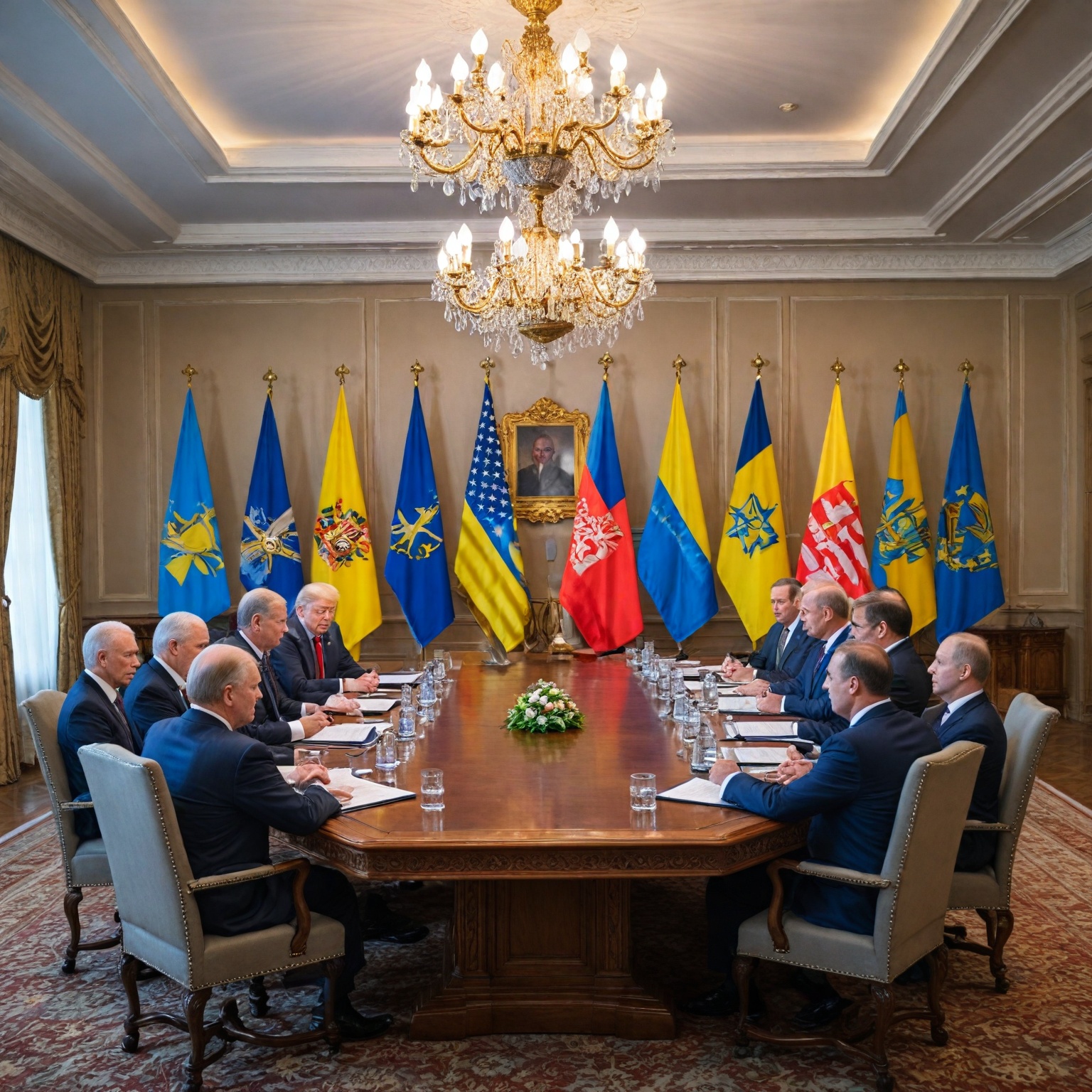
Summary
The conflict between Russia and Ukraine, which escalated dramatically with Russia’s full-scale invasion in February 2022, has become one of the most significant geopolitical crises in recent history, reshaping European security and global diplomatic relations. In response to the protracted war and widespread international concern, former U.S. President Donald Trump, after his return to office in early 2025, launched an ambitious diplomatic initiative aimed at securing a peace deal within 100 days. This effort involved intensified negotiations with both Moscow and Kyiv, seeking to leverage U.S. influence to halt hostilities and establish a sustainable settlement despite ongoing military confrontations.
Russia’s military strategy throughout the conflict has focused on incremental territorial gains, especially in eastern Ukraine, while demanding recognition of its annexations as a precondition for peace talks. Conversely, Ukraine, under President Volodymyr Zelenskyy, has maintained a firm stance insisting on full restoration of its sovereignty, including the return of Crimea and the Donbas region, rejecting any proposals perceived as compromising national integrity. These irreconcilable positions, coupled with deep mutual distrust and the involvement of multiple international actors, have complicated diplomatic efforts and prolonged negotiations.
The peace initiatives have included various international proposals, such as China’s 12-point peace plan calling for ceasefire and security guarantees, and European-led summits aimed at facilitating dialogue. However, these attempts have faced criticism and skepticism from Western governments, who accuse some actors of advancing narratives favorable to Russia or seeking to freeze the conflict to Russia’s advantage. Within the United States, internal debates and tensions between the Trump administration, Ukrainian officials, and other stakeholders have further challenged the coherence of the peace process.
Despite these obstacles, the Trump administration’s push for a rapid peace settlement underscores the complexity of balancing military realities with diplomatic imperatives in a conflict that continues to cause severe humanitarian, economic, and security repercussions. While no definitive agreement has been reached, the framework established during this period highlights the ongoing international commitment to resolving the war, even as the conflict’s trajectory remains uncertain and volatile.
Background
The conflict between Russia and Ukraine began in 2014 following Russia’s annexation of Crimea, marking the start of an ongoing and complex confrontation that has shaped European security dynamics for years. Despite initial clashes, the situation eventually transitioned into an active stalemate characterized by regular shelling and skirmishes along frontlines. This period of tension culminated in a full-scale Russian invasion in February 2022, dramatically escalating the conflict and prompting widespread international concern about regional stability and global economic repercussions, including disruptions to supply chains and food security.
In the months leading up to the invasion, U.S. intelligence and military assessments indicated a near-certain large-scale Russian offensive, highlighted in a White House briefing in October 2021. Western officials became increasingly pessimistic about Ukraine’s military prospects as the war progressed, with reports of substantial Ukrainian desertion rates and significant territorial gains by Russian forces, including the capture of Kurakhove and its power station. The involvement of Russian private military companies, notably the Wagner Group, intensified hostilities, especially in contested areas such as Bakhmut and southern Zaporizhzhia Oblast, where fierce fighting resulted in heavy casualties on both sides.
Efforts to negotiate peace have been ongoing but fraught with difficulties. Kremlin spokespersons have indicated some progress while emphasizing Russia’s determination to protect its interests and maintain dialogue with the United States, although contacts have remained strained. Ukrainian President Volodymyr Zelenskyy has maintained that peace talks require a full Russian withdrawal from occupied territories and has expressed skepticism toward some diplomatic overtures, including those involving U.S. envoys accused of spreading Russian narratives. Meanwhile, international actors such as China have proposed peace plans calling for ceasefires, security guarantees, and respect for territorial integrity, though these initiatives have received mixed reactions from Western governments.
The conflict’s persistence and escalation have placed immense pressure on global diplomatic efforts, with leaders from Ukraine, Russia, the United States, and Europe outlining their respective ambitions and red lines for a future peace settlement. The situation remains highly volatile, with concerns about potential dangerous escalations, including the possible use of nuclear weapons, underscoring the urgent need for a sustainable resolution.
Recent Developments in the Ukraine Conflict
Since 2024, the conflict in Ukraine has seen intensified military operations and complex diplomatic maneuvers. In May 2024, Russian forces launched an offensive in the Kharkiv region, achieving some territorial gains before the advance stalled. However, subsequent fall and winter campaigns enabled Russia to deepen its control in eastern and southeastern Ukraine, particularly in Donetsk, where it seized over 4,000 square kilometers of territory. Despite these advances, the frontlines largely remained in a state of active stalemate, characterized by frequent shelling and skirmishes. In January 2025, Ukraine mounted a second incursion, although progress was limited due to a rapid Russian response. Notably, over 10,000 North Korean troops participated alongside Russian forces during these offensives, suffering heavy casualties and eventually being withdrawn by February 2025.
The size and organization of Russian military forces in Ukraine have evolved significantly throughout the conflict. At the beginning of 2023, Russian troop numbers were estimated at approximately 360,000, marked by disorganization. By June 2023, this figure had risen to about 410,000 with improving structure, and by early 2024, the Operational Group of Forces in occupied territories comprised around 470,000 troops. Over the summer of 2023, Russia attempted to standardize its military units, moving away from reliance on private military companies like Wagner, especially following the Wagner mutiny.
Russia’s military strategy appears to focus on gradual territorial gains intended to exert leverage on Kyiv to accept peace terms favorable to Moscow. This strategy hinges on the anticipated depletion of Ukrainian munitions as Western military aid becomes limited. The Kremlin’s planning horizon targets achieving a strategic victory by 2026, utilizing any battlefield advances as bargaining chips in negotiations.
Diplomatic efforts have been marked by entrenched positions and fluctuating willingness to negotiate. Russia’s annexation of four Ukrainian regions in 2022 and subsequent demands that these be recognized as a precondition for peace talks have complicated negotiations. Russian officials, including President Vladimir Putin and Foreign Minister Sergey Lavrov, have stipulated conditions such as Ukraine’s formal renunciation of NATO membership, recognition of Russian territorial claims, and the lifting of sanctions. Moscow has also expressed openness to a “new world order” concept aimed at countering U.S. global influence. Conversely, Ukrainian leadership, notably President Volodymyr Zelenskyy, has insisted that peace is unattainable without the return of Crimea and the Donbas region to Ukraine, emphasizing national sovereignty and territorial integrity. Negotiations have produced working groups to address key themes of Zelenskyy’s peace proposals, although mutual distrust remains high.
The United States has played a significant role in supporting Ukraine through substantial military aid exceeding $50 billion by early 2023, including advanced weaponry and equipment. Prior to the 2022 invasion, U.S. policy favored settling the Donbas conflict under the Minsk agreements, but post-invasion support has shifted decisively toward sustaining Ukraine’s defense efforts. U.S. leadership has publicly committed to leveraging diplomatic influence to achieve a sustainable peace, acknowledging the complexity and difficulty of forthcoming negotiations.
Meanwhile, reports indicate Russia has communicated a list of demands to the United States for a resolution to the conflict and a reset of bilateral relations. However, details of these demands and Russia’s readiness to engage in direct peace talks with Kyiv remain unclear. The evolving diplomatic landscape underscores the challenges facing any prospective peace deal amidst ongoing military confrontations and deep geopolitical tensions.
Geopolitical and Diplomatic Strategies
Since the full-scale Russian invasion of Ukraine in February 2022, diplomatic efforts to resolve the conflict have been characterized by complex negotiations and divergent geopolitical strategies among key global actors. The war, marking the largest military conflict in Europe since World War II, has drawn intense international attention with leaders from Ukraine, Russia, the United States, and Europe outlining their positions, ambitions, and red lines for a potential peace agreement.
U.S. Diplomatic Initiatives and Peace Efforts
Under the direction of President Trump, the United States has aimed to promote peace by exercising “strong, decisive leadership” to secure a sustainable resolution to the war. Trump’s administration expressed readiness to engage in complex negotiations involving both Russia and Ukraine, emphasizing a focus on peace and diplomatic solutions. U.S. efforts have also included significant military and financial support to Ukraine, amounting to over $50 billion by early 2023, which comprises advanced weaponry and defense systems designed to bolster Ukraine’s resistance against Russian aggression.
Despite these efforts, diplomatic channels have encountered difficulties. Kremlin spokesman Dmitry Peskov acknowledged some progress in peace settlement talks but highlighted ongoing challenges in U.S.-Russia communications. Moscow maintains it is open to dialogue but insists on safeguarding its strategic interests, complicating the prospects for an agreement. Meanwhile, U.S. officials have expressed frustration over Ukrainian President Volodymyr Zelenskyy’s criticism of certain U.S. envoys, which they view as unhelpful to the peace process.
Ukrainian and Russian Positions
Ukraine, led by President Zelenskyy, has firmly maintained that any peace deal must include the restoration of its sovereignty over Crimea and the Donbas region. Zelenskyy explicitly stated that Ukrainians are unwilling to cede these territories to Russia, underscoring the nation’s determination to uphold its territorial integrity. Conversely, Russian leadership, including President Vladimir Putin and Foreign Minister Sergei Lavrov, has articulated maximalist objectives aimed at reshaping the geopolitical order, with Lavrov advocating for negotiations that create a “new world order” countering U.S. hegemony.
Russian officials have conditioned peace talks on international recognition of the “new territorial realities” following Russia’s annexations, a stance that has been a major stumbling block in negotiations. Putin’s rhetoric as recently as January 2024 suggested that Russia’s objectives remain uncompromising, effectively demanding Ukrainian and Western surrender.
Role of International and Regional Actors
The peace process has involved a multitude of international players and proposals. European countries have increased their involvement, with France hosting high-level meetings that included U.S., Ukrainian, British, and German representatives, signaling a shift toward more European engagement in peace efforts. Denmark expressed willingness to host a peace summit in July 2023 aimed at fostering dialogue and involving influential Global South countries such as India, Brazil, and China to broaden support for peace.
China has positioned itself as a mediator by proposing a 12-point peace plan emphasizing ceasefire, dialogue, and security guarantees for Russia while advocating the protection of civilians and territorial integrity. However, Western officials criticized China’s approach, accusing it of attempting to “freeze” the conflict to Russia’s advantage and deepen divisions within the West. Russia has welcomed China’s efforts, but only on terms that include recognition of its annexations.
Brazilian President Lula has highlighted that many Global South nations desire peace but noted that both Putin and Zelenskyy remain convinced of eventual victory, thus rejecting negotiations. The United Nations has also been proposed as a venue for peace summits, though Russia’s potential participation has been conditioned on accountability measures such as war crimes investigations.
Challenges and Outlook
The convergence of geopolitical ambitions, national interests, and international diplomacy defines the current state of peace negotiations, where any progress depends on overcoming deep mistrust and reconciling competing demands for territorial sovereignty, security guarantees, and global power balances.
Diplomatic Negotiations and Peace Initiatives in the Past Year
Over the past year, diplomatic efforts to resolve the conflict between Russia and Ukraine have been marked by complex negotiations, competing proposals, and shifting international involvement. Ukrainian President Volodymyr Zelenskyy has consistently emphasized that peace talks with Russia are contingent on Moscow’s full withdrawal from occupied territories, rejecting any plan that would “freeze” the conflict without resolving underlying issues. This stance was reiterated after meetings with African leaders in Kyiv, underscoring Kyiv’s insistence on territorial integrity as a prerequisite for negotiations.
Several international actors have sought to mediate or influence the peace process. In February 2023, Chinese Foreign Minister Wang Yi announced that Chinese leader Xi Jinping would present a peace proposal, later formalized in a 12-point paper emphasizing ceasefire, dialogue, security guarantees for Russia, civilian protection, and respect for territorial integrity. However, this proposal received mixed reactions from Western countries, who criticized China for portraying the West as exacerbating the conflict by supplying Ukraine with weapons. The United Nations also played a role, with Ukrainian Foreign Minister Dmytro Kuleba suggesting a February 2023 peace summit mediated by Secretary-General António Guterres, though Russia conditioned its participation on Ukraine recognizing the sovereignty of annexed regions, which Kyiv rejected.
The United States under former President Trump pushed for a peace framework characterized by strong, decisive leadership and readiness to broker a sustainable resolution. U.S. Secretary of State Marco Rubio indicated that the Trump administration was prepared to abandon talks if progress was not achieved within days, signaling impatience with protracted negotiations. Behind the scenes, Russia presented the U.S. with a list of demands aimed at ending the war and resetting bilateral relations, though details remained unclear and it was uncertain whether Russia was willing to engage Kyiv directly before these demands were accepted. Kremlin spokesman Dmitry Peskov acknowledged some progress but warned of difficult discussions ahead, highlighting Moscow’s goal to safeguard its interests while remaining open to dialogue with Washington.
Despite these diplomatic overtures, tensions and military actions continued on the ground. Russia launched a significant offensive north of Kharkiv in May 2024, capturing several villages and causing civilian displacement. This assault occurred after a four-month hiatus in U.S. weapons supplies due to a congressional stalemate that was resolved in April 2024. The fragile diplomatic environment was further complicated by Ukrainian skepticism toward some U.S. envoys, with President Zelenskyy accusing Trump’s special envoy of spreading Russian narratives, a move that U.S. officials viewed as unhelpful to peace efforts.
European nations also expressed willingness to contribute to peace initiatives. Danish Foreign Minister Lars Løkke Rasmussen offered to host a summit in July 2023 aimed at fostering dialogue between Ukraine and Russia, emphasizing the importance of engagement from Global South countries such as India, Brazil, and China, which have voiced a desire for peace but observed entrenched positions from both Moscow and Kyiv. Meanwhile, discussions in London and Paris focused on ceasefire proposals, including a 30-day truce aimed at limiting missile and drone attacks, while avoiding direct clashes between coalition forces and Russia.
Throughout these efforts, the balance between advancing negotiations and maintaining military support for Ukraine has been delicate. While some officials anticipated continued U.S. diplomatic leadership, questions lingered over the future scale of military assistance, especially in light of reports that deliveries had significantly decreased. The cumulative diplomatic initiatives over the past year reflect the complexity and high stakes of achieving a lasting peace, with competing demands and strategic calculations shaping the trajectory of the conflict and its resolution attempts.
Timeline of Key Events
The conflict between Russia and Ukraine, which began in 2014, evolved into an active stalemate marked by regular shelling and skirmishes along the frontlines. In October 2021, extensive U.S. intelligence assessments forecasted a near-certain large-scale Russian invasion, prompting high-level briefings involving U.S. intelligence, military, and diplomatic leaders.
Throughout late 2024 and early 2025, Russian military forces were projected to peak, with anticipated material challenges developing into 2025. Russian strategic planning aimed for a gradual victory by 2026, with offensive operations intended to exhaust Ukrainian munitions and force Kyiv to capitulate on Moscow’s terms.
Diplomatic efforts intensified as multiple parties sought to mediate peace. At the United Nations General Assembly, China proposed a peace plan emphasizing a ceasefire, dialogue, security guarantees for Russia, civilian protection, and respect for territorial integrity
International Reactions and Involvement
International responses to the conflict between Russia and Ukraine have been multifaceted, involving diplomatic efforts, economic sanctions, military assistance, and peace negotiations. Various global actors have engaged in efforts to shape the trajectory of the war and its resolution.
Diplomatic Initiatives and Peace Efforts
Several countries and international organizations have pursued diplomatic avenues to resolve the conflict. China proposed a plan at the United Nations General Assembly that called for a ceasefire, dialogue, security guarantees for Russia, protection of civilians, and respect for territorial integrity. China also accused Western nations of exacerbating the conflict by supplying arms to Ukraine. While Ukrainian President Volodymyr Zelensky expressed a willingness to meet with Chinese President Xi Jinping to advance mutual interests and global security, no specific arrangements for such a meeting were made public.
European nations have played an increasingly active role in peace efforts. A notable event was the Paris meeting hosted by French President Emmanuel Macron, which included U.S. officials, representatives from Ukraine, the United Kingdom, and Germany. This gathering marked a shift towards greater European involvement in the U.S.-led peace process. U.S. Senator Marco Rubio described the talks as “very positive” and anticipated further European participation, with follow-up meetings planned in London. German Foreign Minister Annalena Baerbock emphasized Europe’s crucial role in supporting Ukraine both militarily and economically, including potential agreements related to mineral resources.
Russia’s stance on negotiations has been uncompromising regarding territorial issues. Following Russia’s annexation of four Ukrainian regions, Kremlin spokesman Dmitry Peskov insisted that recognition of these territorial changes was a prerequisite for any meaningful talks. Similarly, Russian Foreign Minister Sergei Lavrov articulated a desire for negotiations to focus on establishing a “new world order” to counteract U.S. hegemony. Russia has also expressed openness to resolving the conflict through political and diplomatic means, provided its territorial gains are acknowledged.
Military Assistance and Sanctions
The international community, particularly Western countries, has imposed extensive sanctions targeting Russian individuals, financial institutions, businesses, and trade, aiming to debilitate Russia’s economy and restrict its war-making capabilities. These sanctions have evolved since the prelude to Russia’s 2022 invasion and intensified thereafter. Military aid to Ukraine has been coordinated primarily through the Ukraine Defence Contact Group, comprising over fifty countries including all NATO members. From early 2022 to early 2024, international assistance to Ukraine amounted to approximately $380 billion, reflecting a significant commitment to Ukraine’s defense.
The United States has been a key provider of military support. Under the Presidential Drawdown Authority, the U.S. Department of Defense has been able to continuously supply Ukraine with defense articles and services, ensuring ongoing support regardless of fiscal year constraints. However, some aspects of U.S. peace diplomacy, including security guarantees, remain under discussion and have yet to be finalized.
U.S. and Russia Dynamics
Former U.S. President Donald Trump’s approach to the conflict has raised concerns among NATO allies due to his direct diplomacy with Russian President Vladimir Putin and critical remarks about President Zelensky. Trump suggested the possibility of a deal between Russia and Ukraine but also acknowledged the human cost of the war. The Kremlin has hinted at potential business incentives aimed at the U.S. administration to ease economic sanctions, although substantive progress remains elusive.
Experts have expressed skepticism about Russia’s long-term goals and the possible outcomes of the conflict, noting the paradox of Russia potentially emerging with a “war economy” and geopolitical leverage despite the devastation caused in Ukraine. The evolving international involvement reflects the complex interplay of geopolitical interests, regional security concerns, and the humanitarian imperative to end the conflict.
Impact and Consequences
The ongoing conflict between Russia and Ukraine has led to significant military, economic, and geopolitical repercussions. One major impact has been the extensive damage to Ukraine’s infrastructure, particularly its energy sector. Russian strikes, conducted under the doctrine called the “Strategic Operation for the Destruction of Critically Important Targets” (SODCIT), have severely crippled Ukraine’s domestic power generation, destroying approximately 9 gigawatts (GW) of capacity by mid-June 2024. Given that Ukraine’s peak winter consumption in 2023 was around 18 GW, this destruction accounted for about half of the country’s total energy production capacity, leading to widespread power shortages and civilian hardship.
Militarily, Russia has adopted a strategy aimed at gradually wearing down Ukrainian forces by limiting Western military aid and depleting Ukrainian munitions. This approach is designed to enable Russia to achieve incremental territorial gains, which it intends to leverage to force Ukraine into capitulation on terms favorable to Moscow. The Russian leadership’s planning horizon for securing a decisive victory is set for 2026, reflecting a long-term strategic calculation rather than a rapid battlefield success.
The prolonged conflict has also complicated diplomatic efforts to reach a peace settlement. U.S. President Donald Trump, after reengaging with Russian President Vladimir Putin in early 2025, set a 100-day deadline for his administration to secure a peace deal. However, negotiations have been fraught with challenges, including Russia’s delay in agreeing to a ceasefire and conflicting interests among international actors. While Ukraine has shown some openness to ceasefire discussions, it maintains firm conditions such as the restoration of Crimea and the Donbas region, which Russia currently controls. This stance, articulated by Ukrainian President Volodymyr Zelenskyy, reflects the deep-seated territorial and sovereignty issues at the core of the conflict.
The conflict has also seen continued military operations, with Russia launching offensives in eastern Ukraine, notably in the Kharkiv and Donetsk regions, gaining thousands of square kilometers of territory despite some setbacks. Ukrainian counteroffensives have been met with stiff resistance, complicated by the involvement of foreign forces such as over 10,000 North Korean troops supporting Russian efforts until their withdrawal in early 2025. Both sides have sustained significant casualties, and attacks on civilian areas, including Ukrainian drone strikes on Russian territory, have escalated tensions.
From an international perspective, the war has prompted extensive Western support for Ukraine, with the United States alone providing over $50 billion in aid by early 2023. This aid encompasses advanced weaponry and equipment critical to Ukraine’s defense. Conversely, Russia faces economic sanctions from Western countries, which it has sought to circumvent through proposed business deals with the United States, adding complexity to the diplomatic landscape.
Finally, the conflict has affected broader security and alliance dynamics. Prior to the 2022 invasion, Ukraine’s aspirations to join NATO were met with resistance from some European nations due to Russian opposition. Over time, perspectives have shifted, with influential voices like Henry Kissinger advocating for Ukraine’s NATO membership as a desirable outcome. However, territorial disputes and the ongoing war continue to complicate Ukraine’s Euro-Atlantic integration.
Controversies and Criticisms
The peace negotiations and proposals surrounding the Russia-Ukraine conflict have been met with significant controversy and criticism from various stakeholders. Polish diplomat Jakub Kumoch notably criticized analyses that he believed accepted the Russian narrative too readily, highlighting that fundamental disagreements over Ukraine’s borders, disarmament, and security guarantees prevented any meaningful progress toward an agreement. This viewpoint underscores the complexity and deep-rooted nature of the diplomatic impasse.
China’s role as a mediator also attracted mixed responses. While Russia publicly appreciated China’s efforts and expressed willingness to pursue a political and diplomatic resolution that recognized the “new territorial realities” following Russia’s annexations, Western leaders remained skeptical of China’s 12-point peace proposal, which included calls for a ceasefire and security guarantees for Russia but also blamed Western arms supplies to Ukraine for escalating the conflict. This ambivalence reflects broader geopolitical tensions influencing the peace process.
Statements by Russian officials further complicated perceptions of the negotiation process. Kremlin spokesman Dmitry Peskov acknowledged some progress but emphasized ongoing challenges, including difficult communications with the United States and the necessity of protecting Russian interests. Russian President Vladimir Putin’s conditional support for a 30-day ceasefire was tempered by references to unresolved “nuances,” notably the contentious issue of Ukraine’s borders, which remains a central stumbling block in peace talks.
The involvement of U.S. officials also sparked debate. While the Trump administration expressed a strong commitment to achieving peace, frustrations emerged over Ukrainian President Volodymyr Zelenskiy’s public criticism of Trump’s special envoy, Steve Witkoff, accusing him of propagating Russian narratives—a charge that U.S. officials deemed counterproductive to the peace process. This incident highlighted the delicate balance and mistrust inherent among the negotiating parties.
Legacy and Future Outlook
The efforts to secure a peace deal in Ukraine under former President Donald Trump’s administration reflect a complex legacy marked by intensive diplomacy amid ongoing conflict. The negotiations have involved multiple actors, including the United States, Russia, Ukraine, and other international stakeholders, highlighting the intricate balance between pursuing peace and addressing strategic interests. While the draft agreement, spanning approximately 80 pages, signifies progress toward a framework that acknowledges significant U.S. material and financial support to Ukraine since the 2022 invasion, the details remain subject to ongoing discussions.
The legacy of these negotiations is characterized by a dual-track dialogue: one focused on resetting U.S.-Russia relations and the other on achieving a sustainable peace agreement in Ukraine. This approach underscores the administration’s attempt to leverage diplomatic channels to halt hostilities, despite evident challenges and divisions within the U.S. government on how to proceed. Notably, high-level talks in cities like Paris and London have been described as positive and substantive, though Kremlin officials caution that many difficult discussions remain ahead.
Looking forward, the future outlook for peace remains cautiously optimistic but uncertain. Russian officials emphasize the complexity of negotiations and the need to safeguard their interests while remaining open to dialogue. Meanwhile, Ukrainian representatives have shown a willingness to engage in talks under the guidance of U.S. leadership, indicating potential for compromise if tough decisions are made on both sides. The ongoing support from the U.S. Department of Defense, including the use of Presidential Drawdown Authority to supply defense articles to Ukraine, suggests that Washington intends to maintain leverage and support throughout the process regardless of fiscal timelines.
The broader geopolitical context continues to influence prospects for peace. The stalemate on the battlefield, alongside regional tensions and concerns over security guarantees, has made any resolution delicate. China’s 12-point peace proposal and calls for ceasefire, dialogue, and protection of civilians add further dimensions to the international discourse, though Western responses have been mixed. Additionally, the potential for business incentives and easing of sanctions has been floated as a possible element to facilitate an agreement, but these remain contentious issues.
In sum, the legacy of Trump’s push for a Ukraine peace deal is one of determined diplomatic engagement amidst a protracted and volatile conflict. While no definitive peace has yet been achieved, the framework laid during this period and ongoing negotiations may serve as a foundation for future settlement efforts, contingent on the political will and concessions of the involved parties.
The content is provided by Avery Redwood, Know Heaven