Summary
Protests against former President Donald Trump and his administration erupted nationwide beginning in early 2025, marking one of the largest and most geographically widespread movements of political dissent in recent U.S. history. Unlike earlier demonstrations centered primarily in Washington, D.C., these protests strategically expanded to state capitals, federal buildings, congressional offices, parks, and city halls across all 50 states, as well as in several international cities. Organized by coalitions including Indivisible, MoveOn, and the 50501 Movement, the demonstrations united diverse groups—ranging from civil rights advocates and labor unions to LGBTQ+ organizations—in opposition to Trump’s policies and political influence.
The protests addressed a broad spectrum of issues, including opposition to immigration enforcement actions, cuts to social programs, and perceived corruption within the administration. Demonstrators employed varied tactics, from rallies and teach-ins to community service activities, reflecting both grassroots energy and coordinated planning. Participation was significant and diverse, with estimates of millions involved nationwide and sustained activity in major cities such as New York, Chicago, Portland, and Los Angeles, as well as smaller communities across the country. The movement also attracted international attention, with solidarity protests held in cities like London, Paris, and Berlin.
Law enforcement responses to the protests have been a source of considerable controversy. Agencies frequently used tear gas, rubber bullets, and other crowd-control measures, sometimes indiscriminately and against journalists, legal observers, and medics, drawing widespread criticism from human rights organizations. The Trump administration escalated security measures by deploying federalized National Guard troops, Marines, and SWAT-style teams in key cities, sparking debates over militarization and civil liberties. Additionally, proposals to invoke the Insurrection Act to suppress demonstrations raised serious concerns about executive overreach and prompted bipartisan calls for judicial oversight and legislative safeguards.
The protests exemplify the deep political polarization and civic activism during Trump’s presidency, highlighting a nationwide and global coalition opposing his administration’s policies and leadership style. Despite facing challenges such as aggressive law enforcement tactics and legislative efforts to restrict protest activities, organizers and participants sustained a multifaceted resistance movement that reshaped political discourse and mobilized a broad spectrum of the American public.
Background
The protests against former President Donald Trump have drawn significant attention for their widespread geographic reach and diverse motivations. Unlike earlier demonstrations that largely concentrated in Washington, D.C., the “Hands Off” protests sought to decentralize activism by organizing events across the United States, including state capitols, federal buildings, congressional offices, Social Security headquarters, parks, and city halls. These efforts were coordinated by established groups such as Indivisible and MoveOn, which previously led protests on abortion rights, gun violence, and racial justice during Trump’s first administration.
The protests have been characterized by both grassroots energy and strategic coordination. Many actions have been driven by the broader public, not only through established organizations but also via spontaneous participation during non-political events such as the Super Bowl. The momentum generated by these demonstrations has influenced political discourse, with reports indicating increased activism among Democrats, particularly in states like Georgia. This surge in civic engagement has, in some cases, intensified divisions within congressional caucuses regarding cooperation with Trump.
Specific incidents have underscored the intensity of the protests. For example, in Portland, Oregon, police declared a riot area around the city’s ICE facility following confrontations that involved smashing windows and the deployment of tear gas to disperse demonstrators. Additionally, some protests have involved acts of property damage, including the graffitiing, window-breaking, and arson of a limousine owned by a Muslim immigrant, which also spread fire to a nearby Fox News crew vehicle.
The scope of protest issues has expanded beyond opposition to Trump himself, encompassing reactions to his Cabinet members and key figures associated with his administration, such as Elon Musk, whose goals and actions have also become points of contention. Overall, the protests reflect a broad coalition of causes and participants united by a shared resistance to policies and political directions associated with Trump’s presidency.
Timeline of Events
Protests against President Donald Trump and his policies have occurred nationwide, often coordinated to coincide with significant dates and events. One of the earliest notable protest days was branded “Not My Presidents Day,” referencing demonstrations held on Presidents’ Day at both state capitals and cities across the United States. During this period, activists also organized a boycott called the Economic Blackout and planned the Stand Up for Science 2025 event in late February and early March, aiming to highlight economic and scientific concerns under the administration.
In February, protests took place simultaneously with a military parade in Washington, D.C., marking the Army’s 250th anniversary. These demonstrations occurred amid heightened tensions, including National Guard deployments in Los Angeles to counter anti-ICE protests, reflecting the broad spectrum of dissent against Trump’s policies.
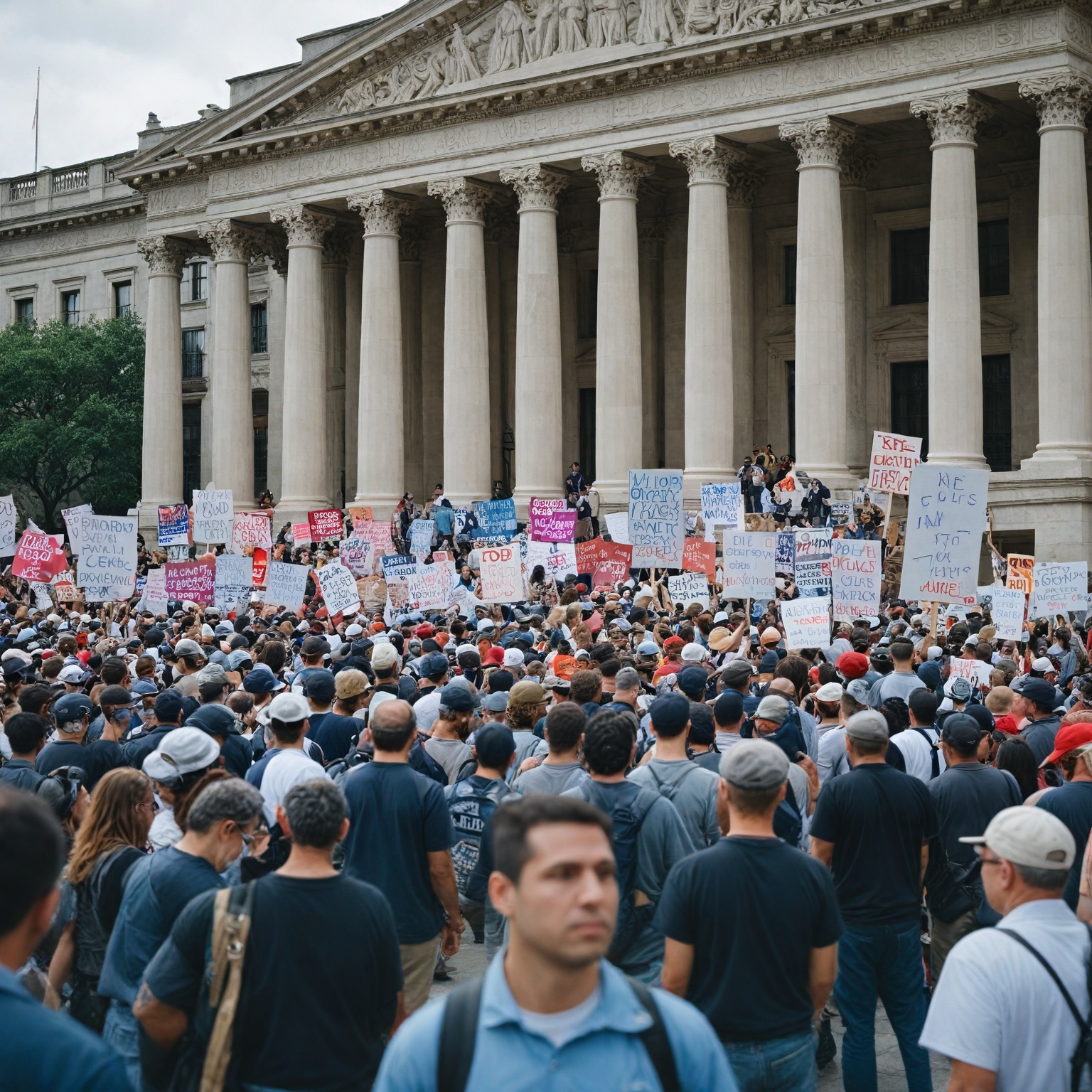
April 19 marked a significant day of nationwide protests in all 50 states. Thousands gathered at various locations including state capitols, federal buildings, congressional offices, Social Security headquarters, parks, and city halls, demonstrating a strategic effort by organizers to spread activism beyond Washington, D.C., into local communities across the country. The protests included diverse activities ranging from rallies and demonstrations to community service-oriented events such as food drives and teach-ins.
Further activity in early June 2017 saw both opposition and support demonstrations. On June 3, while nationwide March for Truth protests called for impartial investigations into Russian interference in the 2016 presidential election, a smaller “Pittsburgh not Paris” flash mob rally gathered in support of Trump’s decision to withdraw from the Paris Agreement. This juxtaposition highlighted the polarized nature of public responses to the administration’s policies.
Throughout this period, protests were not confined to the United States. Thousands rallied internationally in cities like Berlin, Paris, and London, opposing both Trump and prominent figures associated with his administration, such as Elon Musk. Protests outside Tesla dealerships criticized Musk’s role in federal government downsizing, demonstrating how opposition extended to individuals perceived as influential in shaping policy.
Geographic Spread and Participation
Protests against the Trump administration occurred nationwide, encompassing both large metropolitan areas and smaller communities across the United States. Demonstrations took place in major cities including New York City, Washington, D.C., Chicago, Los Angeles, Denver, Philadelphia, Portland, and Minneapolis, as well as in numerous smaller cities and towns such as Bozeman and Butte, Montana, and West Hollywood, California. Events were also held in U.S. territories and extended internationally to cities like London, Paris, Prague, and various locations across Mexico, reflecting a global dimension to the movement.
The scale of participation varied, with organizers reporting that more than 600,000 people had signed up to attend nationwide events, while some groups claimed that millions took part in protests coast to coast. For instance, in Manhattan, the protest stretched nearly 20 blocks along Fifth Avenue, while tens of thousands gathered around the Washington Monument in the nation’s capital. Chicago saw thousands flooding Daley Plaza and adjacent streets, and in Philadelphia, crowds marched to landmarks such as the Philadelphia Museum of Art, where political figures addressed attendees.
Participation was notably diverse and involved a broad coalition of groups including civil rights organizations, veterans, women’s rights advocates, labor unions, and LGBTQ+ communities. The protests also featured significant grassroots involvement, with many demonstrations organized by wider public participation beyond established political organizations. While some locations experienced strong turnout from Latino communities and other minority groups, others, such as Denver, noted a decreased presence due to fears related to immigration enforcement.
The protests were often coordinated through national networks and movements, such as Indivisible, the 50501 Movement, and the Democracy Action Network, which facilitated both localized actions and large-scale coordinated events. Demonstrations were characterized by high visibility, with efforts to ensure accessibility and widespread geographic coverage, including over 1,200 protests planned across the country on some occasions.
In several cities, the protests maintained a sustained presence, occurring on multiple occasions and sometimes merging with other activist causes. For example, in Portland, multiple demonstrations combined into a unified march with a determined but positive atmosphere. Other protests were sparked by specific policy issues, such as the raids by Immigration and Customs Enforcement (ICE) in Los Angeles or opposition to proposed cuts in federal programs and attacks on marginalized communities.
Organizers and Key Figures
The protests against the Trump administration were spearheaded by a broad coalition of activist groups and grassroots organizations, with notable leadership from Indivisible, MoveOn, and the 50501 Movement. Indivisible, in collaboration with a nationwide coalition that includes civil rights organizations, veterans, women’s rights groups, labor unions, and LGBTQ+ advocates, played a central role in mobilizing participants across the country and even internationally in cities such as London and Paris.
The 50501 Movement, a decentralized network named to represent “50 protests in 50 states and one movement,” orchestrated protests at state capitols and was involved in coordinating nationwide actions since early February 2025. This group has been instrumental in promoting demonstrations against the Trump administration and related policies, including a recent “Tesla Takedown” campaign holding more than 100 protests.
In addition to these leading organizations, a wide range of activist groups participated in the protests, each focusing on various issues. LGBTQ+ rights groups such as the Christopher Street Project, Bulletproof Pride, Pride At Work, and the Center for LGBTQ Economic Advancement and Research were active participants. Economic justice advocates included Americans for Tax Fairness, the Strong Economy for All Coalition, and the Consumer Federation of America. Religious activist organizations like the Interfaith Alliance, Unitarian Universalists for Social Justice, and the New York Jewish Agenda also contributed to the movement.
The protests saw significant grassroots involvement and community organizing efforts. For example, groups like “Sisters of the Resistance” used private group chats to coordinate attendance and provide mutual support among protesters, emphasizing the need for sustained, long-term activism. The Democracy Action Network (DAN), in coalition with Indivisible and the 50501 Movement, organized regional protests, such as a march in West Hollywood, California, demonstrating opposition not only to the Trump administration but also to Elon Musk’s leadership of the Department of Government Efficiency (DOGE).
Organizers articulated clear demands focused on combating what they described as “the billionaire takeover and rampant corruption” of the administration, opposing cuts to social programs like Medicaid and Social Security, and defending vulnerable communities including immigrants and transgender people. Furthermore, civil liberties groups like the ACLU engaged in legislative advocacy to limit executive overreach and protect democratic norms, emphasizing bipartisan efforts to restrict the use of laws like the Insurrection Act.
Protester Demographics and Motivations
The protests against the Trump administration saw participation from a broad and diverse range of demographic groups, reflecting widespread opposition across different communities. Nearly 600,000 people had signed up to attend the nationwide events, which were organized to be accessible and highly visible throughout the country, with some demonstrations also taking place internationally in cities like London and Paris. Among those who recently attended protests focused on racial issues, approximately 41% were younger than 30 years old, a notable contrast to the 19% representation of this age group among the general U.S. adult population.
The motivations behind the protests were multifaceted, encompassing a variety of social, economic, and political concerns. Activist groups involved included organizations advocating for LGBTQ+ rights such as the Christopher Street Project and Pride At Work; economic justice groups like Americans for Tax Fairness and the Strong Economy for All Coalition; as well as religious activists from groups like the Interfaith Alliance and Unitarian Universalists for Social Justice. National coalitions brought together civil rights organizations, veterans, women’s rights advocates, labor unions, and LGBTQ+ groups to present a unified opposition to the administration’s policies.
The core demands articulated by protest organizers included an end to the concentration of wealth and corruption within the Trump administration, protection and restoration of federal funding for social programs including Medicaid and Social Security, and opposition to attacks on immigrants, transgender individuals, and other marginalized communities. Organizers emphasized that the administration’s policies disproportionately affected vulnerable populations such as veterans, children, seniors, farmers, and political opponents, framing the protests as a struggle against systemic inequality and power imbalances.
In sum, the protests represented a large-scale and inclusive movement driven by intersecting issues of social justice, economic fairness, and civil rights, mobilizing a diverse coalition of activists and citizens across the United States.
Methods and Tactics
The protests against the Trump administration employed a wide array of methods and tactics, reflecting the diverse objectives and organizing strategies of participants nationwide. Demonstrations were often highly coordinated by grassroots organizers, particularly in states like California, but also took place across both large metropolitan areas and smaller cities throughout the country.
Organizers utilized various forms of public assembly, including rallies, teach-ins, and mutual aid efforts such as food drives and volunteering at local shelters. Some protests targeted specific figures associated with the administration, such as billionaire Trump adviser Elon Musk, with planned demonstrations outside Tesla dealerships protesting his role in government downsizing. These community service-oriented events often accompanied more traditional protest activities, signaling a multifaceted approach to resistance.
The scale of mobilization was unprecedented, with the “Hands Off!” protests on April 5, 2025, marking the largest one-day nationwide display of public opposition to the administration. These protests took place in over 1,400 locations across all 50 states, drawing estimates of three to five million participants. The “Hands Off!” rallies united disparate grievances into a single message of resistance, with more than 1,300 separate events occurring simultaneously across the country.
However, the protests were not without controversy regarding policing methods. Law enforcement agencies frequently employed tear gas, pepper spray, and “less lethal” projectiles such as sponge rounds and rubber bullets. These tactics were sometimes used in ways that deviated from their intended purpose, including firing projectiles directly at individuals, deploying tear gas in confined spaces, and targeting not only protesters but also journalists, legal observers, and street medics. Such actions have been widely criticized as abuses, prompting calls for law enforcement to revise their crowd control policies to align with international human rights standards.
In addition to street demonstrations, some factions advocated for legislative measures aimed at curbing protest activities. For instance, model legislation drafted by advocates like Meyers called for federal enforcement actions invoking statutes such as the Racketeer Influenced and Corrupt Organizations (RICO) Act to address organizations perceived as deploying civil unrest for political ends.
Law Enforcement and Security Measures
In response to widespread protests against the Trump administration, law enforcement agencies across the United States adopted a range of security measures, some of which sparked controversy due to allegations of excessive force and militarized tactics. The deployment of federalized National Guard units, active-duty Marines, and specialized law enforcement teams was a significant component of the government’s strategy to manage demonstrations and immigration enforcement actions.
President Donald Trump authorized the deployment of National Guard troops to several states, including California and Texas, to manage protests related to immigration raids and other federal policies. In California, hundreds of demonstrators protesting immigration raids faced a heavy security presence, with troops standing guard outside federal buildings. Texas Governor Greg Abbott activated 5,000 National Guard troops to oversee “No Kings Day” protests across the state. Additionally, the Department of Homeland Security planned to deploy SWAT-style special response teams to cities such as Seattle, Philadelphia, northern Virginia, New York, and Chicago—urban centers led by Democratic officials and historically marked by vocal dissent against the administration.
Law enforcement responses included the use of tear gas, pepper spray, flash-bang grenades, rubber bullets, and sponge rounds, which were employed against protesters, journalists, legal observers, and street medics. Human rights organizations documented numerous abuses, including beatings and indiscriminate firing of so-called “less lethal” projectiles. These tactics raised significant concerns about compliance with international human rights standards, prompting calls for policy revisions and the establishment of best practices for policing demonstrations.
Certain jurisdictions have pledged resistance to federal cooperation efforts, particularly regarding Immigration and Customs Enforcement (ICE) actions. Seattle’s government, known for its history of public protest, has vowed to resist cooperation with ICE, even as federal authorities intensified their enforcement measures. In response, federal orders called on the Attorney
Government and Political Responses
The response of government officials and political actors to the nationwide protests against Donald Trump has been multifaceted and often contentious. Key figures within the administration have advocated for strong measures to control and suppress demonstrations perceived as threatening to law enforcement and public order. Russell Vought, a chief architect of Project 2025 and head of the Office of Management and Budget, publicly argued for invoking the Insurrection Act to deploy the military to quell anticipated protests arising from administration policies.
In line with this approach, federal agencies have increased their presence in cities with significant protest activity, particularly targeting urban centers governed by Democrats. Following the deployment of federalized National Guard units and Marines in Los Angeles to manage protests, Immigration and Customs Enforcement (ICE) announced plans to send SWAT-style special response teams to Seattle, Philadelphia, northern Virginia, New York, and Chicago. These actions signify a deliberate strategy to militarize responses in locations that have drawn sharp criticism from Trump and his allies. Additionally, the Department of Homeland Security published a list of jurisdictions it deemed noncompliant with federal immigration enforcement laws, further heightening tensions between federal authorities and local governments.
Legislative initiatives have also mirrored this tough stance on protest activity. Since early 2025, 41 new anti-protest bills have been introduced across 22 states, a significant increase compared to previous years. These laws aim to impose harsher penalties for protest tactics and restrict the activities of demonstrators. Notably, some proposed legislation seeks to exclude student protesters from receiving federal financial aid or loan forgiveness if they commit crimes, even non-violent misdemeanors, during campus protests. These measures are widely viewed as responses to pro-Palestinian demonstrations, many of which involved masked protesters concerned about retaliation and doxing.
Republican voices have frequently expressed concern over perceived political influence on prosecutorial decisions within the Department of Justice (DOJ). The American Civil Liberties Union (ACLU) has pledged to pursue stronger legislative safeguards against such political interference, highlighting ongoing debates over the impartiality of law enforcement and judicial processes in the context of protest management.
The increasing legislative and enforcement efforts reflect a broader national trend of escalating governmental attempts to regulate and restrict protest activities. This trend has been evident since the early days of the Trump administration, when state legislators in at least 18 states proposed laws to curtail specific protest tactics and enhance penalties for certain forms of civil disobedience. These developments have occurred amid heightened political polarization, with a majority of recent racial justice protesters identifying as Democrats or Democratic-leaning, underscoring the partisan dimensions of contemporary protest movements.
Challenges in Organizing and Coordinating Protests
Organizing and coordinating protests against the Trump administration faced multiple challenges stemming from the scale, diversity, and political tensions of the events. While many protests were driven by pre-existing organizations, there was also significant participation by the wider public, including during non-political events such as the Super Bowl, which added complexity to coordination efforts. Grassroots organizers used digital tools such as group chats—exemplified by the “Sisters of the resistance” chat—to mobilize participants and build community support necessary for sustained activism.
A key difficulty lay in managing the broad geographic spread of protests, which occurred not only in large, predominantly Democratic cities but also in smaller cities across the country, including conservative districts where activists confronted Republican congressmen about their voting records and healthcare policies. This wide distribution required intricate communication and logistical planning to ensure effective and simultaneous demonstrations.
Protesters also faced significant challenges from law enforcement responses, which in some cases involved militarized tactics such as the deployment of federalized National Guard units, marines, and Swat-style special response teams in cities targeted for dissent, including Seattle, Philadelphia, and New York. Such responses complicated coordination by creating heightened risks of violence and arrests. Documented abuses by law enforcement—including beatings, misuse of tear gas, pepper spray, and indiscriminate firing of less-lethal projectiles at protesters, journalists, and legal observers—further threatened protest safety and necessitated calls for law enforcement to revise their policing practices to align with international human rights standards.
Moreover, the presence of counterprotesters added to the challenge, as police were required to uphold the free speech rights of all parties while maintaining order. This often meant keeping antagonistic groups separated but within sight and sound of one another, complicating efforts to maintain peaceful demonstrations.
Despite these challenges, activist groups worked to maintain cohesion and momentum through coordinated nationwide events and solidarity networks, underscoring the resilience of the movement in the face of political and logistical obstacles.
Impact and Aftermath
The nationwide protests against President Donald Trump and his administration had a significant impact on public discourse and law enforcement responses across the United States. Unlike earlier protests concentrated in Washington, D.C., these demonstrations were widely dispersed, taking place in diverse locations such as state capitols, federal buildings, congressional offices, Social Security headquarters, parks, and city halls. This broad geographical spread was a deliberate strategy by organizers to ensure visibility and accessibility for participants nationwide, emphasizing that opposition to the administration existed in every part of the country.
The protests saw an unprecedented level of public engagement, including many first-time protesters and increased leadership roles for women within organizing groups like Indivisible and SwingLeft. The movement, often referred to as “the resistance,” was marked by both the involvement of established organizations and spontaneous participation from the general public, even during non-political events such as the Super Bowl.
Law enforcement responses varied but often involved aggressive tactics. Documented abuses included beatings, misuse of tear gas and pepper spray, and the use of less-lethal projectiles like sponge rounds and rubber bullets against protesters, journalists, legal observers, and medics. These actions prompted calls from civil rights groups and human rights advocates for law enforcement agencies to revise their protest policing policies to align with international human rights standards. Best practice guidelines were also issued to encourage more appropriate handling of demonstrations.
In anticipation of ongoing and future protests, federal authorities escalated their response. Following the deployment of federalized National Guard units and Marines to control demonstrations in Los Angeles, agencies such as Immigration and Customs Enforcement (ICE) planned to send SWAT-style special response teams to several major cities, including Seattle, Philadelphia, northern Virginia, New York, and Chicago—cities with Democratic leadership that had frequently been targeted by Trump’s rhetoric. These deployments were reported to be in preparation for expected weekend protests, reflecting a shift towards a more militarized approach to crowd control.
The possibility of invoking the Insurrection Act to deploy the military domestically was also discussed within the administration. Russell Vought, chief of the Office of Management and Budget and a key figure behind Project 2025, argued in private meetings for its use to suppress anticipated protests arising from administration policies. This proposal raised significant concerns about civil liberties, leading to bipartisan calls for narrowly defined conditions, time-limited deployments, and judicial oversight if the Act were to be used. Organizations such as the ACLU committed to legislative efforts to safeguard protest rights in response to these developments.
Despite curfews and police efforts to control protest locations, demonstrators often maintained a visible presence near government buildings. For example, during protests in Los Angeles, police managed to control streets around City Hall but continued to disperse crowds to maintain order. Similar scenes occurred in Austin, Texas, where protesters cleared roads near federal buildings after brief standoffs with police.
Criticism and Controversies
Protests against the Trump administration have faced various criticisms and controversies related both to the actions of protesters and the response of law enforcement. Some protesters have been accused of engaging in violent behavior, including attacking or looting buildings, setting cars on fire, and blocking roads. In reaction, law enforcement officers, often equipped with riot gear, have used flash-bang grenades, rubber bullets, and other non-lethal tactics to control crowds, which has raised concerns about excessive use of force.
Human rights organizations such as Amnesty International have documented numerous instances of police misuse of so-called “less lethal” weapons like rubber bullets and sponge rounds. These have reportedly been used indiscriminately, sometimes aimed at protesters’ heads or fired at close range, causing severe injuries including permanent disabilities like blindness and skull fractures. Chemical irritants such as tear gas and pepper spray have also been criticized when deployed against peaceful demonstrators, journalists, legal observers, and street medics. Calls have been made for law enforcement agencies to revise their policies to better align with international human rights standards and to adopt best practices for policing demonstrations.
On the political front, some figures have expressed dissatisfaction with the opposition’s response to the Trump administration. For instance, feminist commentator Camille Paglia harshly criticized Democratic leadership, particularly Senator Chuck Schumer, describing the party’s reaction as a “disgraceful episode” marked by a “nationwide orgy of rage and spite” without moral authority.
Additionally, there have been concerns about the potential invocation of the Insurrection Act to deploy the military against protesters. Russell Vought, a key architect of Project 2025 and current chief of the Office of Management and Budget, advocated for the use of this Act to suppress anticipated protests arising from administration policies. However, there is widespread support among civil liberties groups and bipartisan lawmakers for imposing narrow, clearly defined conditions on such deployments, ensuring they are time-limited and subject to judicial review. The American Civil Liberties Union (ACLU) and allied organizations continue to push for stronger safeguards to prevent abuse of executive power in this context.
Furthermore, protests have sparked international reactions; for example, the Chinese Consulate in San Francisco warned Chinese exchange students and visiting scholars to avoid participating in protests, reflecting concerns about the broader impact and perception of these demonstrations.
The content is provided by Sierra Knightley, Know Heaven