Elevate Your Food Experience: Uber Eats Introduces Cutting-Edge AI Tools for Menu Descriptions and Food Images!
Summary
Elevate Your Food Experience: Uber Eats Introduces Cutting-Edge AI Tools for Menu Descriptions and Food Images is a technological initiative by Uber Eats aimed at enhancing the online food ordering experience through advanced artificial intelligence (AI) applications. As a global leader in food delivery, connecting over 320,000 restaurants across more than 500 cities worldwide, Uber Eats has integrated generative AI and machine learning models to automate and improve menu descriptions, enhance food photography, and summarize customer reviews, thereby providing richer and more personalized content for users and merchants alike.
This suite of AI-driven tools includes bulk generation of detailed menu item descriptions, automated enhancement of food images—such as lighting adjustments, digital re-plating, and portion augmentation—and the extraction of actionable insights from customer feedback. These innovations aim to improve menu clarity, visual appeal, and user engagement while streamlining operations for restaurant partners, particularly those without point-of-sale integration. Additionally, features like live order chat and incentivized user-generated food photos foster direct interaction and authentic content sharing between customers and merchants.
Despite the promise of improved customer experience and measurable business benefits such as increased conversion rates and user satisfaction, Uber Eats’ AI image enhancement has sparked controversy. Critics and some restaurant owners have raised concerns about the realism and accuracy of AI-generated food images, noting instances where enhanced visuals misrepresent dishes and potentially harm restaurant reputations. This controversy highlights ongoing challenges in balancing technological innovation with authenticity and consumer trust within the food delivery industry.
Looking forward, Uber Eats plans to refine these AI capabilities and expand their application to areas such as augmented reality menus, predictive analytics, and enhanced operational efficiencies including delivery optimization and error resolution. These efforts underscore Uber Eats’ commitment to leveraging cutting-edge AI technologies to transform the digital food ordering landscape and meet evolving consumer demands.
Background
Uber Eats operates as a major player in the food delivery industry, connecting users to over 320,000 restaurant partners across more than 500 cities in 36 countries worldwide. To enhance user experience, Uber Eats has integrated machine learning (ML) models that analyze user preferences, order histories, and browsing behaviors to provide personalized meal recommendations. These models leverage advanced techniques such as word embeddings derived from dish descriptions and features extracted from food images, enabling the platform to effectively match users with restaurants and cuisines that align with their tastes.
In addition to personalized recommendations, Uber Eats is pioneering the use of artificial intelligence (AI) to augment various aspects of its service. Recent innovations include the deployment of generative AI tools designed to create enriched menu descriptions, enhance food photography, and generate concise review summaries. These AI-driven enhancements aim to assist restaurants in better advertising their offerings and improving communication with customers through new features such as live chat support and payment options for user-submitted photos.
This AI-centric approach builds upon Uber’s existing technological infrastructure originally developed for its transportation services. By adapting these capabilities to e-commerce functions, Uber Eats efficiently manages mobile food ordering, delivery logistics, and payment processing, thereby expanding the utility of its platform beyond ride-sharing to food delivery and related services. Moreover, the company is exploring the integration of autonomous vehicles for delivery, reflecting its commitment to leveraging cutting-edge technology to optimize operational efficiency and user satisfaction.
Development and Technology of AI Tools
Uber Eats has integrated advanced artificial intelligence technologies to enhance various aspects of its platform, particularly focusing on menu descriptions, food image enhancement, and customer review summarization. These AI tools are designed to improve user experience by providing more informative and visually appealing content, while also streamlining operations for merchants.
The development of these AI capabilities leverages human-in-the-loop processes combined with sophisticated tooling such as uLabel, which is part of Uber AI Solutions’ extensive data annotation services. Uber AI Solutions brings over nine years of experience in managing large-scale data labeling operations, offering a broad suite of more than 30 advanced capabilities including image and video annotation, semantic segmentation, and object tracking. This expertise ensures that AI models are trained on high-quality, nuanced data, contributing to the accuracy and cultural relevance of the outputs provided to users globally.
For menu descriptions, Uber Eats has introduced a bulk AI-generated description feature. This tool allows merchants to generate multiple item descriptions simultaneously, saving time and improving menu conversion rates. The AI suggests descriptive text that merchants can review, edit, and approve via the Menu Maker interface on Uber Eats Manager. This capability is especially valuable for non-POS integrated merchants, enabling scalable content updates across their menus.
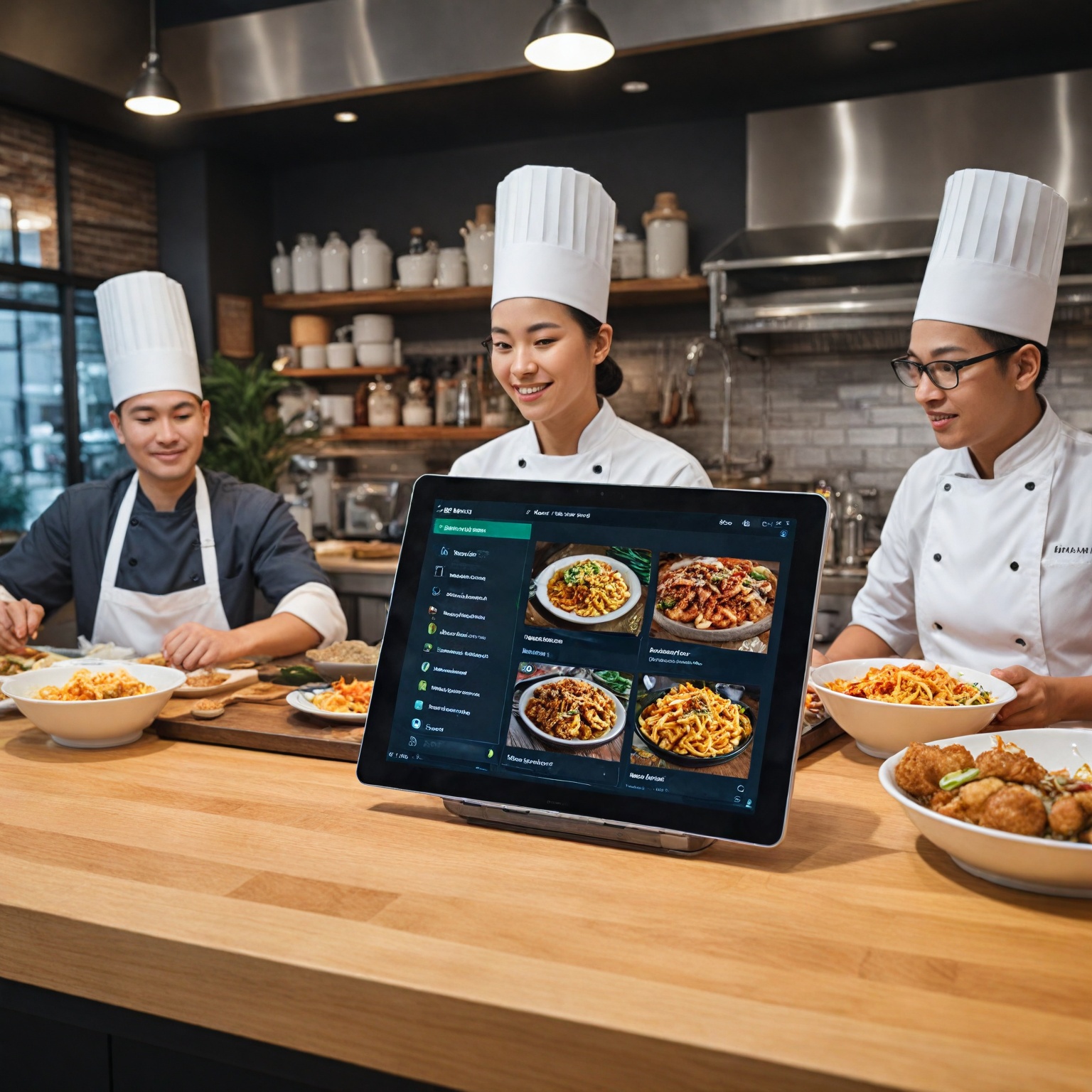
In the realm of food image enhancement, Uber Eats uses AI to detect low-quality images and automatically improve them through adjustments in lighting, resolution, framing, and even digital re-plating of food onto different plates or backgrounds. Some enhancements appear to incorporate generative AI techniques to expand food portions or fill gaps within images, creating more appealing visual representations. However, the implementation of text-to-image AI in this context has received mixed reviews, with users noting that generated images sometimes fall short of realistic expectations.
Additionally, AI is utilized to analyze and summarize customer reviews, enabling quick identification of feedback that highlights areas for business improvement. This functionality helps restaurants better understand customer sentiments and adapt accordingly.
Together, these AI-driven tools reflect Uber Eats’ commitment to employing cutting-edge technology and expert data annotation to enhance the food ordering experience for both merchants and customers, facilitating localized, high-quality interactions across diverse markets.
Features and Functionalities of AI Tools
Uber Eats has integrated a suite of advanced AI tools designed to enhance the overall user experience by improving menu descriptions, food imagery, and customer feedback processing. Central to these innovations is the use of generative AI, which enables the platform to automate and optimize various aspects of its service.
One of the primary functionalities is the generation of detailed menu descriptions. Using AI, Uber Eats can create bulk-generated textual descriptions for menu items, allowing merchants—especially those without POS integration—to quickly add or update item details in just a few clicks. This feature helps businesses provide clearer information to customers and potentially boost menu conversion rates. Merchants have the option to review, approve, or edit the AI-suggested text via the Menu Maker tool in Uber Eats Manager.
In addition to text, Uber Eats employs AI to enhance food images on its platform. The system detects low-quality food photos and applies improvements such as adjusting lighting, resolution, and framing. Beyond simple enhancements, generative AI may digitally alter the food items themselves by expanding portions or filling in gaps when re-plating images, as well as changing plates or backgrounds to create more appealing visuals. This capability aims to help restaurants better advertise their offerings, although early implementations have faced criticism for image quality and realism.
Another AI-powered feature is the summarization of customer reviews. The tool analyzes feedback to highlight key points and areas for improvement, providing businesses with actionable insights without the need to manually sift through extensive reviews. Complementing these AI functions, Uber Eats has introduced a “Live Order Chat” tool to facilitate direct communication between merchants and customers, enhancing real-time support and engagement.
To enrich the review experience further, Uber Eats now allows customers to upload their own food photographs when submitting reviews. This user-generated content can supplement AI-enhanced images and provide a more authentic representation of menu items. In select regions such as the US, UK, Canada, and Mexico, customers may also receive in-app credits as incentives for contributing photos.
Looking ahead, Uber Eats is exploring additional AI applications such as augmented reality (AR) menus, which could allow users to visualize food items before ordering, and advanced predictive analytics to better forecast demand fluctuations and tailor service offerings accordingly. These developments underscore Uber Eats’ commitment to leveraging AI technology to elevate the food ordering experience for both merchants and consumers alike.
Implementation and Deployment
Uber Eats has integrated advanced AI technologies to enhance the user experience through multiple innovative features. The deployment of generative AI enables the creation of improved menu descriptions and the summarization of customer reviews, providing clearer and more appealing information for users. Additionally, AI-driven image enhancement tools improve the quality of food photos by adjusting lighting, resolution, and even digitally altering food presentation or backgrounds to make the dishes more enticing.
To support direct communication between merchants and customers, Uber Eats has introduced a “Live Order Chat” feature, facilitating real-time interaction and assistance during the ordering process. Furthermore, users in select countries such as the US, UK, Canada, and Mexico can now upload their own photos with reviews, incentivized through in-app credits, thus promoting community engagement and authentic content sharing.
These AI capabilities are powered by a combination of automated and manual language quality assurance processes to ensure localization is both accurate and culturally relevant, aiding Uber Eats in expanding into new markets with trust and precision. The deployment strategy incorporates ongoing measurement of qualitative and quantitative metrics, including customer experience scores, resolution speed, automation rates, and productivity gains to optimize AI performance and its impact on business outcomes.
Uber Eats also offers an API that allows developers to integrate its food ordering and delivery functionalities into third-party applications, enabling access to menus, placing orders, and tracking deliveries seamlessly through customized software solutions. This technological infrastructure, initially designed to support ride-sharing logistics, has been adapted effectively to power Uber Eats’ e-commerce operations, including mobile food ordering and payments.
Reception and Impact
The introduction of advanced AI tools by Uber Eats to enhance menu descriptions and food images has generated a mixed reception among users and restaurant partners. On the positive side, the integration of generative AI has been praised for its potential to improve customer experience by making menu items more visually appealing and providing richer, more personalized food descriptions. For example, users can now upload their own photos with reviews, and the AI can digitally enhance images by expanding or filling gaps in food presentations, creating a more engaging browsing experience. This innovation aligns with broader industry trends where companies leverage AI to boost user engagement and satisfaction, as evidenced by improvements in metrics such as click-through rates and incremental gross bookings following AI-driven recommendation enhancements.
However, not all feedback has been favorable. Some restaurant owners and customers have expressed concerns that AI-generated images may sometimes misrepresent dishes, potentially damaging a restaurant’s reputation and leading to customer dissatisfaction. There have been reports highlighting cases where AI-enhanced imagery made menu items look less appetizing, sparking worries about the legal and business implications for affected establishments. This tension underscores the challenge of balancing technological advancement with authenticity and trust in the food delivery sector.
From a broader perspective, the deployment of such AI features contributes to the ongoing transformation of food delivery services by integrating conversational agents and personalized recommendations, thereby aligning with consumer demand for more tailored and interactive experiences. Uber Eats’ experimentation with AI also demonstrates the measurable business impact of these technologies, as their controlled experiments and A/B testing have shown meaningful gains in user engagement and satisfaction.
At the same time, the rapid expansion of AI capabilities has broader infrastructural implications. The increasing demand for powerful AI models is driving a surge in data center construction and resource consumption globally, raising questions about the sustainability of such innovations.
Challenges and Limitations
Despite the innovative integration of AI tools within Uber Eats to enhance menu descriptions, customer reviews, and food imagery, several challenges and limitations have been identified. One primary concern is the quality and realism of AI-generated images. Critics argue that the current state of AI imagery often results in visuals that are of poor quality and lack authenticity, which undermines the appeal of the food products being offered. This issue is particularly significant because food imagery is a crucial factor in influencing customer choices, and unrealistic images can diminish trust and user experience.
Moreover, the use of AI-generated food images in a food delivery context has been met with skepticism. Some users and industry observers question the suitability of AI product imagery for food delivery apps, highlighting that even professionally taken real photographs of food often face criticism for being misleading regarding portion size and freshness. This skepticism extends to AI images, which can exaggerate or distort the appearance of food items, potentially leading to consumer disappointment.
In response to the challenges of image quality, Uber Eats employs AI not only to create new images but also to detect and enhance low-quality food photos by adjusting lighting, resolution, and framing. However, this process may involve digitally altering food items or placing them on different plates or backgrounds, which raises further concerns about authenticity and accuracy in representation.
Another limitation relates to the contextual accuracy of AI recommendations and image enhancements. While the platform leverages AI to learn user preferences and optimize search results, there is an inherent complexity in ensuring that these AI-driven suggestions accurately reflect individual tastes and cultural nuances in cuisine selection. Additionally, the reliance on human-annotated data and collaboration with partners like Uber aims to improve model performance, but the overall system remains challenged by the variability and subjectivity inherent in food presentation and user preferences.
Future Developments and Prospects
Uber Eats continues to explore the integration of artificial intelligence (AI) to further enhance the food delivery experience. Future developments are expected to focus on refining AI-generated content, such as menu descriptions and food images, to better meet consumer expectations and increase engagement. Although early implementations of AI-generated food imagery have faced criticism for poor quality and unrealistic representations, Uber Eats aims to improve these systems, recognizing that high-quality visual content is essential for effective product presentation.
Beyond imagery, Uber Eats plans to expand AI applications across various operational aspects. This includes improving the accuracy of food preparation time predictions, optimizing delivery routes for faster service, and personalizing restaurant and food recommendations based on individual customer preferences. By leveraging AI models that project diverse data types—such as dish descriptions, images, and restaurant features—into unified representations, the platform can deliver more relevant and efficient service.
Furthermore, AI will play a critical role in error resolution and customer support. For instance, when incorrect orders occur, AI can analyze photos and track the lifecycle of items to identify where mistakes happened, facilitating quicker refunds or reorders. In grocery delivery, AI-driven real-time communication between consumers and shoppers, along with preference-based suggestions, promises to enhance satisfaction and operational efficiency.
The content is provided by Jordan Fields, Know Heaven