
Summary
A cutting-edge semiconductor fabrication plant in China is poised to begin production of Huawei’s advanced artificial intelligence (AI) chips, marking a significant milestone in the country’s drive toward technological self-reliance amid ongoing geopolitical tensions. The plant, which began construction around 2022, incorporates state-of-the-art manufacturing facilities such as SiCarrier and SwaySure, and aims to produce Huawei’s Ascend series of AI processors, including the high-performance Ascend 920 and the upcoming Ascend 910C chips. These chips utilize a 6-nanometer process node and deliver competitive computational capabilities, signaling China’s narrowing technological gap with global semiconductor leaders.
Huawei’s semiconductor initiative is a key component of China’s broader strategy to reduce dependence on foreign technology in the face of escalating U.S. export restrictions that limit access to advanced chipmaking equipment and design tools. Despite these challenges, the plant reflects substantial investment and innovation, including collaborations with domestic foundries like Semiconductor Manufacturing International Corporation (SMIC) and the development of a comprehensive supply chain encompassing wafer fabrication, memory technologies, and AI model integration. The fabrication facility is expected to bolster China’s AI infrastructure and commercial technology sectors, with potential military applications underscoring its strategic significance.
However, Huawei’s production efforts face considerable hurdles, particularly low manufacturing yields due to restricted access to critical equipment such as extreme ultraviolet (EUV) lithography machines and electronic design automation (EDA) software. These constraints have delayed mass production and limited output, challenging Huawei’s ability to compete with established global players like Nvidia, TSMC, and ASML. Nevertheless, the ongoing expansion of fabrication capacity—projected to reach 50,000 wafers per month by late 2024—and investments in domestic alternatives reflect China’s commitment to overcoming technological bottlenecks.
The establishment of this fabrication plant exemplifies China’s accelerating efforts to build a self-sufficient semiconductor ecosystem amid intensifying U.S.-China tech competition. It has prompted policy responses such as the CHIPS Acts in the United States and Europe, aimed at strengthening Western semiconductor industries in response to China’s growing capabilities. As Huawei continues to innovate under these constraints, the plant’s successful launch could reshape the global semiconductor landscape by challenging the dominance of traditional industry leaders and advancing China’s role in AI chip production.
Background
China’s ambitions to develop a self-reliant semiconductor industry have intensified in recent years, driven by the need to reduce dependence on foreign technology amid escalating US-China tech tensions. Central to these efforts are advanced fabrication plants such as the SwaySure and SiCarrier facilities, which have rapidly materialized since construction began in 2022. SiCarrier, a spin-off from a Huawei laboratory and reportedly supported by a Shenzhen state fund, kept a low profile for several years before publicly showcasing around 30 chipmaking tools—including etching, testing, and deposition equipment—at the Semicon conference in Shanghai.
Huawei, one of China’s leading technology giants, is at the forefront of this push with its development of cutting-edge AI chips. Its Ascend series, notably the Ascend 920 and the upcoming Ascend 910C, represents significant strides in Chinese semiconductor design and manufacturing. The Ascend 920 chip, produced using a 6nm process node, delivers over 900 teraflops of BF16 performance per card and features a memory bandwidth of 4Tbps, marking a 30-40% improvement in performance compared to previous generations. Despite facing challenges in mass production and yield rates due to US trade restrictions, Huawei aims to begin large-scale manufacturing of the Ascend 910C in early 2025, targeting competition with Nvidia’s high-performance AI processors.
While China has not yet achieved global state-of-the-art semiconductor manufacturing, as seen in the 7nm chips powering new Huawei phones, the technological gap is narrowing despite external hurdles. The development and deployment of these advanced fabrication capabilities not only bolster China’s commercial technology sector but also carry potential military implications. The increasing investment and progress in domestic chip production signal growing independence in semiconductor technology, challenging the dominance of Western firms and prompting legislative responses such as the CHIPS acts in the US and Europe aimed at revitalizing their own semiconductor industries.
The Fabrication Plant
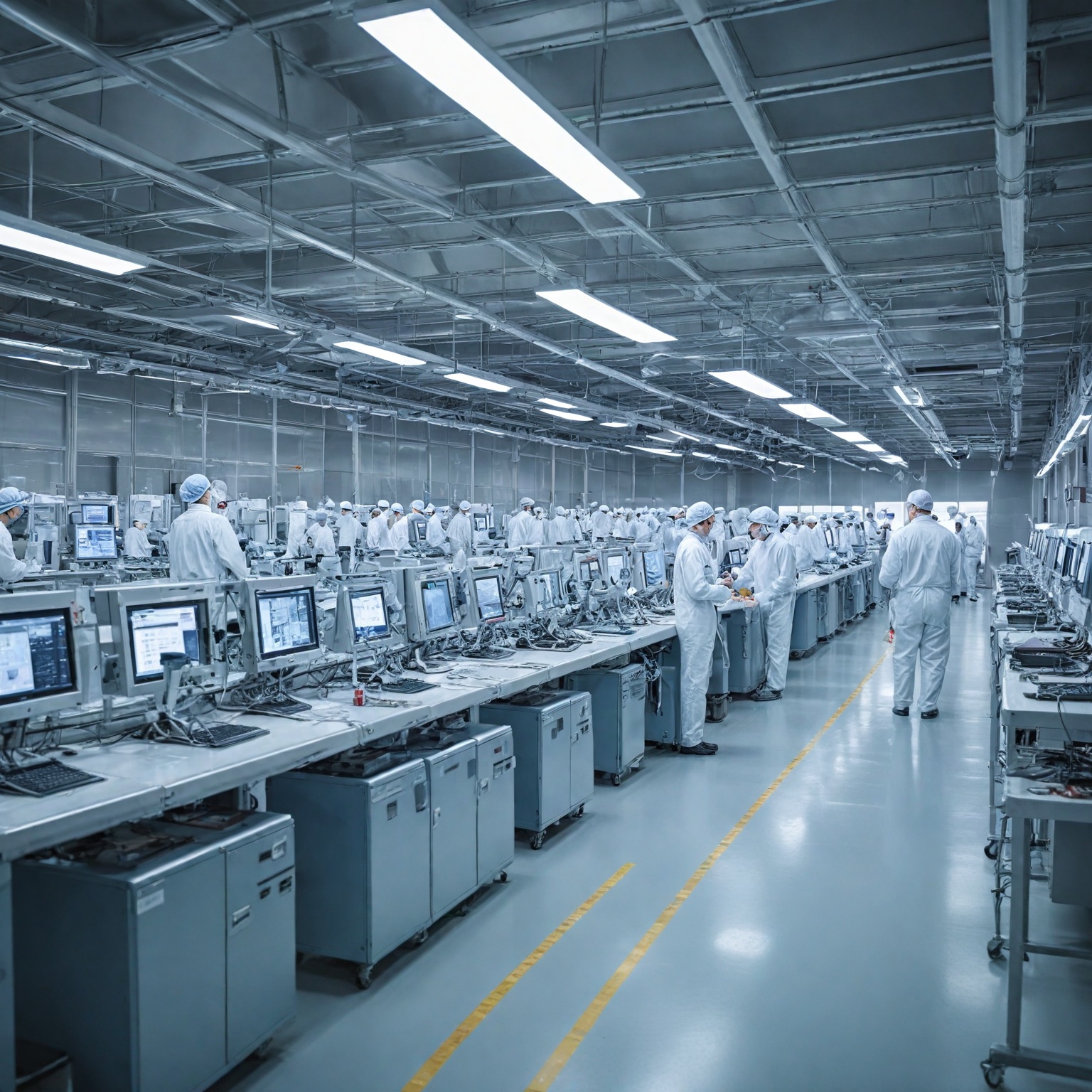
The fabrication plant dedicated to producing Huawei’s advanced AI chips has been described as one of the “8th wonders of the world” due to the extraordinary precision and scale involved in its construction and operation. The design and establishment of the plant reportedly took over a decade and involved an investment of billions of dollars. Construction is believed to have commenced in 2022, with significant progress visible through satellite imagery showing rapid development of the distinctively designed factories, including the SwaySure and SiCarrier facilities.
Despite ongoing U.S. export restrictions and a technological gap in key manufacturing equipment, including extreme ultraviolet (EUV) lithography machines predominantly made by ASML, China’s semiconductor industry has made considerable strides. While Chinese chip manufacturing currently lags behind global leaders by two to three generations—especially in mass production of 7 nm chips widely used since 2018 in devices like the iPhone XS—the gap is gradually narrowing due to persistent investment and innovation efforts.
The plant’s production targets reflect ambitious growth, with SMIC’s SN1 and SN2 projects (announced in 2017) progressing steadily. SN1 reached 15,000 wafers per month (WPM) by the end of 2020 and aimed for 35,000 WPM by the end of 2022. Installation of SN2 equipment is expected to complete by mid-2024, with an overall capacity of 50,000 WPM projected by the end of that year. This increase in production capacity is critical to scaling up the supply of Huawei’s AI chips domestically, reducing reliance on foreign suppliers and potentially supporting military applications.
Huawei’s approach involves a comprehensive development of the AI supply chain, encompassing wafer fabrication equipment and AI model building to achieve greater self-reliance. The potential to boost production significantly depends on controlling yields and managing critical inputs such as high-bandwidth memory (HBM), fabrication tools, servicing, and essential chemicals like photoresist. If these challenges are overcome, the fabrication plant will be instrumental in fulfilling the growing demand for Huawei’s AI chips, such as the Ascend 910C series, thereby reinforcing China’s position in the global semiconductor industry.
AI Chips Produced at the Plant
Huawei’s new fabrication plant is set to produce some of the company’s most advanced AI chips, including the Ascend 920 series, which utilize a 6nm process node technology. These chips are designed to deliver exceptional performance, with the Ascend 920 expected to offer more than 900 teraflops (BF16 performance) per card alongside a memory bandwidth of 4Tbps, representing a significant leap in computational capabilities. The plant is also involved in testing the upcoming Ascend 910D chips, while mass production of the Ascend 910C—the predecessor to the Ascend 920—is anticipated to begin shortly, serving primarily Chinese customers.
Huawei’s chip development efforts reflect a broader strategic response to ongoing export restrictions imposed by the United States on advanced semiconductor technologies. Prior to these controls, Huawei’s Ascend 910 series, originally fabricated by Taiwan Semiconductor Manufacturing Company (TSMC) using a 7nm process node, had established a strong position in AI hardware for data centers and cloud computing applications. The new plant represents a move towards greater self-reliance in chip manufacturing, aiming to reduce dependence on foreign suppliers while advancing indigenous technology capable of competing with industry leaders such as Nvidia, ASML, SK Hynix, and TSMC.
The Ascend 910B series, Huawei’s second generation of AI chips, features multiple models (910B1 through 910B4) with reported clock speeds reaching up to 1.65 GHz, enabling theoretical performance levels that rival or exceed comparable Nvidia GPUs like the A100, which delivers 312 FP16 TFLOPS. The design of these chips emphasizes optimized throughput between vector and matrix units to avoid bottlenecks and maximize AI processing efficiency. These advancements demonstrate Huawei’s commitment to pushing the boundaries of AI hardware performance while adapting to the constraints imposed by geopolitical factors.
In addition to standalone chip performance, Huawei is leveraging the Ascend series in larger system architectures such as its CloudMatrix 384 (CM384), which integrates 384 Ascend 910C chips in an all-to-all network topology. This design compensates for individual chip performance differences by scaling out, enabling the platform to outperform competing Nvidia GPUs in specific AI model workloads, thereby reshaping AI infrastructure capabilities. Through these innovations, the plant is poised to play a central role in advancing China’s position in the global AI semiconductor industry.
Strategic Significance
Huawei’s emergence as a leader in China’s semiconductor industry marks a pivotal shift in the nation’s pursuit of technological self-reliance. Central to this effort is the integration of the entire semiconductor supply chain under Huawei’s control, allowing the company to subsidize critical but unprofitable manufacturing stages and accelerate development of “key and core technologies” essential for advanced chip production. This transformation positions Huawei not merely as a telecommunications giant but as the orchestrator of a national semiconductor ecosystem that aligns with China’s broader strategic goal of independence from foreign suppliers.
The new fabrication plant dedicated to producing Huawei’s AI chips is emblematic of this shift. Despite persistent hurdles imposed by U.S. trade restrictions and challenges in scaling production yields, the facility is poised to manufacture cutting-edge AI processors such as the Ascend 910C and Ascend 920, which deliver substantial performance gains vital for AI applications across data centers and autonomous systems. These advances demonstrate Huawei’s growing ability to innovate domestically while reducing reliance on external technology providers, thereby strengthening China’s chip supply chain resilience.
Moreover, Huawei’s semiconductor progress contributes to narrowing the technological gap with global leaders, as exemplified by their development of 7 nm chips that approach international state-of-the-art standards despite sanctions aimed at limiting China’s capabilities. The maturation of Huawei’s semiconductor infrastructure carries significant implications for both commercial and military sectors, with advanced chip production likely enhancing China’s defense technology.
Huawei’s role also stimulates the wider Chinese technology ecosystem. Its success encourages other firms to invest in domestic chip design and manufacturing, fostering a competitive yet coordinated national effort toward semiconductor self-sufficiency. This initiative has geopolitical resonance, intensifying the U.S.-China tech rivalry, especially as Huawei’s production capacity grows amidst increasing international restrictions. Furthermore, Huawei’s strategy of recruiting talent from leading global chipmakers, such as TSMC, underscores its commitment to overcoming technological barriers and accelerating innovation through human capital acquisition.
In sum, the launch of Huawei’s AI chip fabrication plant symbolizes a significant milestone in China’s strategic drive for technological autonomy. It reflects a comprehensive national push supported by government policies, corporate ambition, and a robust industrial ecosystem aimed at securing China’s position in the critical and competitive semiconductor landscape.
Challenges and Constraints
Huawei’s efforts to ramp up production of advanced AI chips face significant challenges primarily due to U.S.-led export restrictions and technological bottlenecks. Since 2019, Washington has imposed sweeping export controls that bar Chinese companies, including Huawei and its key chip supplier Semiconductor Manufacturing International Corporation (SMIC), from accessing critical American semiconductor manufacturing tools and high-end chips. These restrictions have directly constrained Huawei’s ability to produce top-tier AI processors by limiting access to essential advanced lithography equipment, particularly those used for nodes below 7 nanometers.
One major consequence of these constraints is the difficulty in achieving commercially viable yields. Advanced chips generally require manufacturing yields above 70% to be profitable, but Huawei’s latest SMIC-produced 910B processor achieves only around 50% yield, forcing production delays and order reductions. The subsequent 910C chip, fabricated on SMIC’s N+2 process, has even lower yields near 20%, highlighting the detrimental impact of insufficient lithography tools and other manufacturing equipment. This gap in production efficiency is exacerbated by the inability of Chinese semiconductor equipment manufacturers to produce the full range of advanced machinery needed for state-of-the-art chip fabrication, with no domestic provider capable of fully replacing U.S.-origin technology critical for 7 nm fabs and below.
Moreover, the overall chip design process is hindered by restricted access to electronic design automation (EDA) tools required for advanced node development such as TSMC’s N2 and Samsung’s SF3 processes. This limitation complicates Huawei’s path to creating cutting-edge AI chips and poses a long-term challenge for Chinese semiconductor firms attempting to close the technology gap with global leaders.
Huawei has sought to mitigate these restrictions by supplementing its supply chain with Taiwan’s TSMC. However, U.S. authorities have tightened export controls further, constraining this route and forcing Huawei to prioritize chip allocation toward strategic government and corporate customers. Additionally, China is investing heavily in domestic alternatives and manufacturing capabilities, with new fabrication plants under construction and initiatives aiming to rival leading global players such as ASML, SK Hynix, and TSMC. Nevertheless, the pace of development is hindered by ongoing export controls and the difficulty in replacing sophisticated foreign technology.
Timeline and Milestones
The development of Chinese semiconductor fabrication facilities dedicated to Huawei’s AI chips has seen significant progress since 2017. The initial SN1 and SN2 projects were both announced in 2017, marking the beginning of an ambitious effort to scale domestic chip production. By late 2019, the SN1 facility was producing 3,000 wafers per month (WPM), increasing to 6,000 WPM at the 14 nm node by June 2020. By the end of 2020, SMIC claimed that SN1 had achieved a production capacity of 15,000 WPM, with expectations to reach 35,000 WPM by the end of 2022.
Construction of additional fabrication plants operated by emerging companies such as SiCarrier and SwaySure began in 2022. Satellite imagery analyzed by the Financial Times reveals that these distinctively designed factories rapidly took shape starting from 2022. SiCarrier, a spin-off from a Huawei lab reportedly backed by a Shenzhen state fund, maintained a low profile until making a notable appearance at the Semicon conference in Shanghai in March, where it showcased approximately 30 chipmaking tools including etching, testing, and deposition equipment.
According to industry estimates, all equipment installations for the SN2 project are projected to be completed by July 2024, with combined production capacity across SN1 and SN2 anticipated to reach 50,000 WPM by the end of 2024. This timeline aligns with China’s broader strategy to develop self-sufficient chip manufacturing capabilities amid ongoing export restrictions of advanced semiconductor technologies.
Parallel to fabrication advances, Huawei has distributed samples of its 910C GPU, an architectural evolution in AI chip design, to select technology firms since late 2023. SMIC is reportedly manufacturing key components of the 910C using its N+2 7nm process technology, although yield rates remain low. These milestones reflect the coordinated push by Chinese companies to develop domestically produced AI chips capable of competing with leading global technologies while navigating geopolitical and technological constraints.
Partnerships, Supply Chain, and Ecosystem Development
Huawei’s efforts to develop its AI chip production are supported by a broad and strategically coordinated ecosystem involving multiple partnerships and supply chain investments. The company has invested in about a dozen firms within the semiconductor supply chain, including three chip fabrication facilities linked to Huawei, as revealed by data from Tianyancha, an online company registration platform. Construction on these facilities is believed to have started in 2022, with chip equipment maker SiCarrier and memory-chip maker SwaySure operating two of the sites, reflecting Huawei’s push to establish comprehensive domestic manufacturing capabilities.
Huawei frequently collaborates with Semiconductor Manufacturing International Corporation (SMIC), China’s leading chip manufacturer, to produce its chips, further strengthening its fabrication ecosystem. As of April 2024, Huawei is involved in building or supporting the construction of five semiconductor fabs, underscoring the scale of its fabrication ambitions. This network exemplifies China’s broader strategy of centralizing collaboration between government entities and private sector semiconductor firms, a coordinated effort led by Huawei aimed at reducing reliance on foreign technology and fostering domestic innovation.
In response to export restrictions imposed by the U.S. on advanced semiconductor technologies, Chinese companies—including
Future Prospects and Market Outlook
China’s new approach to semiconductor development, exemplified by the AMEC initiative, reflects a strategic centralization of collaboration between the government and leading private firms such as Huawei. This collaboration aims to bolster domestic chip production capacity, with significant investments in fabs designed to manufacture advanced AI and smartphone chips, including Huawei’s 7nm chips and Ascend AI series. Construction of these facilities began around 2022, with operations involving domestic equipment makers like SiCarrier and memory-chip firm SwaySure, signaling a concerted effort to reduce reliance on foreign technologies amid ongoing export restrictions.
The planned completion of SMIC’s SN2 equipment installations by July 2024 is a critical milestone, positioning SMIC to reach a production capacity of approximately 50,000 wafers per month across its SN1 and SN2 fabs by the end of 2024. This expansion has the potential to significantly increase Huawei’s supply of Ascend AI chips, contingent on improvements in yields and the availability of essential materials such as photoresist and high-bandwidth memory (HBM). However, persistent shortages in key equipment and components continue to widen the technological gap with leading global competitors.
Market observers note that China’s investment in domestic chip production has already yielded tangible results, contributing to a growing degree of independence in semiconductor manufacturing. This shift challenges the current dominance of international players like TSMC, ASML, and SK Hynix, particularly as Chinese firms intensify efforts to develop competitive technologies that can rival these established leaders. The emerging computing architectures enabled by these advancements present opportunities for sustainable growth within China’s computing industry, especially in the context of the ongoing AI revolution.
Nevertheless, questions remain regarding the extent to which Chinese fabs will meet the most advanced technology nodes and how government policies might influence domestic consumption patterns, including preferential support for Huawei smartphones and chips over U.S. alternatives. Despite these uncertainties, the trajectory suggests that China’s semiconductor sector is poised for significant expansion, with the potential to alter the global semiconductor market landscape in the coming years.
The content is provided by Sierra Knightley, Know Heaven